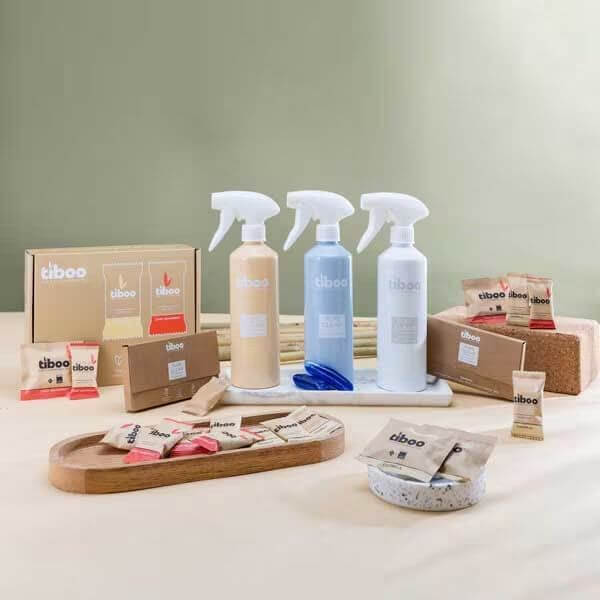
- Using concentrated formulas that require less packaging and less transport weight
- Offering refill systems so the same bottle can be reused many times
- Replacing single-use items (wipes, sponges, plastic scourers) with reusable or compostable equivalents
- Using packaging that is genuinely recyclable in UK kerbside collections, or no packaging at all
- Formulating with ingredients that break down safely rather than accumulating in waterways
What Are Sustainable Cleaning Products? A Practical UK Guide
If you have started swapping single-use plastics for reusable alternatives around your home, cleaning is often one of the last cupboards to change. This guide explains what sustainable cleaning products actually are, how they differ from products simply labelled "eco-friendly" or "natural," and what to look for if you want your cleaning routine to genuinely reduce waste and environmental impact.

It is written for UK households who want practical guidance, not marketing claims.
By the end, you will understand the different types of sustainable cleaning products available, how to tell a meaningful sustainability claim from a vague one, and what trade-offs are worth considering before you switch.
What Does "Sustainable Cleaning Products" Actually Mean?
Sustainable cleaning products are products designed to reduce environmental impact across their full lifecycle, not just at the point of use. This includes how they are made, how they are packaged, how long they last, and what happens to them once they are used up or worn out.
That is a broader definition than many people expect. A spray labelled "eco-friendly" might have a genuinely low-impact formula but still come in single-use plastic. A product made from natural ingredients is not automatically biodegradable or low-waste. Sustainability in cleaning products usually comes from a combination of factors working together, rather than one single feature.
The most common ways cleaning products reduce their footprint include:


Sustainable, Eco-Friendly, Biodegradable: These Words Are Not Interchangeable
One of the most common sources of confusion when shopping for sustainable cleaning products is that related terms get used loosely, sometimes interchangeably, even though they mean different things.
Understanding these distinctions helps you read product labels more critically and avoid choosing something based on a word that sounds reassuring but does not actually describe the feature you care about.
| Term | What it actually means | What it does not mean |
|---|---|---|
| Sustainable | Designed to reduce environmental impact across manufacturing, use and disposal | Zero impact, or automatically better than every alternative |
| Eco-friendly | A general marketing term suggesting reduced environmental harm | A regulated or standardised claim; can mean very little on its own |
| Biodegradable | Breaks down naturally into non-toxic components over time | It will break down quickly, safely, or in every environment |
| Compostable | Breaks down into usable compost under specific composting conditions | It will compost in an ordinary garden compost heap; many need industrial composting |
| Recyclable | Can technically be processed by recycling facilities | It will actually be recycled where you live, or that it is currently accepted by your council |
| Reusable | Designed to be used multiple times rather than discarded after one use | It will last indefinitely, or that it requires no cleaning or maintenance |
| Refillable | Designed so the original container can be topped up rather than replaced | The refill itself is packaging-free or low-impact |
| Plastic-free | Contains no plastic in the product or its packaging | The product is otherwise sustainable |
| Zero-waste | Aims to eliminate waste sent to landfill across the product's use | Literally zero waste is produced |
| Non-toxic | Not harmful to humans or pets in normal use | Free of all chemicals (everything, including water, is a chemical) |
| Natural | Derived from naturally occurring sources | Automatically safer, gentler or more sustainable than synthetic alternatives |
| Plant-based | Formulated primarily from plant-derived ingredients | Free of processing, or automatically biodegradable |
Why Packaging Matters in Sustainable Cleaning
Packaging is one of the most visible parts of a cleaning product's environmental footprint, and it is usually where the biggest, easiest improvements happen.
Concentrated formulas reduce the amount of water being shipped and packaged. A concentrated cleaning tablet or sachet that you dilute at home in your own reusable bottle can dramatically cut the plastic and transport emissions associated with a standard ready-to-use spray, since most of what you are usually paying to ship is water.
Refill systems work on a similar principle. Instead of buying a new plastic bottle every time, you buy one durable bottle and then refill it, either from a pouch, a tablet, or a concentrate. The environmental benefit depends on the bottle actually being reused many times, rather than the refill packaging replacing one type of waste with another.
Packaging material matters too. Cardboard, glass and aluminium are generally easier to recycle consistently across the UK than mixed or flexible plastics, though local council rules do vary, so it is worth checking what your area actually accepts.
Types of Sustainable Cleaning Products
Most sustainable cleaning switches fall into a few practical categories:
Cleaning tablets and concentrates. Small tablets or sachets dissolved in water at home, replacing pre-mixed sprays. These significantly cut packaging weight and volume, though they require you to keep and reuse a spray bottle.
Refillable sprays and liquids. A single durable bottle topped up from larger refill pouches or bulk containers, reducing the number of full plastic bottles bought over time.
Reusable cleaning cloths, such as bamboo or cotton cloths designed to replace disposable paper towels or wipes. These reduce single-use waste but need regular washing, which has its own water and energy cost.
Sustainable scourers and scrubbing tools, often made from natural fibres like coconut husk or plant-based bristles rather than synthetic plastic scourers, which shed microplastics as they wear down.
Laundry products, including concentrated detergents, refillable options, and packaging designed to be fully recyclable or compostable.
Dishwasher products, such as tablets with minimal or plastic-free packaging, compared with conventional gel or liquid products in plastic bottles.
Reusable vs Disposable: What Is the Real Trade-Off?
Reusable products are not automatically the better choice in every situation, and it is worth being honest about the trade-offs.
Reusable cleaning cloths reduce ongoing waste but require washing, which uses water, energy, and sometimes detergent. If you already run a full washing machine load regularly, adding cloths to that load has a marginal cost. If you would need to run extra loads specifically to wash cloths, the environmental case is weaker.
Refillable bottles only reduce waste if you actually keep and refill the same bottle many times rather than replacing it. A refillable system only pays off environmentally after several refill cycles, since the original bottle typically has a higher manufacturing footprint than a standard single-use one.
Concentrated tablets generally have a clear packaging and transport advantage over pre-mixed liquids, with fewer trade-offs, since you are simply adding your own water at home.
The honest summary: switching to reusable and refillable systems tends to reduce waste over time, but the benefit depends on consistent reuse. A reusable product used once or twice before being abandoned can end up worse than a disposable equivalent.
Common Misconceptions About "Eco" Cleaning Products
"Natural means safe." Natural ingredients are not automatically non-toxic, hypoallergenic or better for the environment. Some naturally derived substances can still irritate skin or harm aquatic life if they enter waterways in concentrated form.
"Eco-friendly means zero impact." No cleaning product has zero environmental footprint. Manufacturing, ingredients, transport and disposal all carry some impact. "Eco-friendly" is a relative claim, not an absolute one.
"If it's biodegradable, it breaks down anywhere, quickly." Biodegradability depends heavily on conditions such as temperature, oxygen and microbial activity. A product that biodegrades in an industrial facility may not break down the same way in a landfill or a home compost bin.
"Chemical-free" is a meaningless claim. Water is a chemical. Vinegar is a chemical. Every cleaning product, however natural, is made of chemicals. What matters is which chemicals, in what concentration, and how they are sourced and disposed of.
How to Evaluate a Sustainability Claim Before You Buy
han relying on general labels:
- What exactly is the claim referring to? The formula, the packaging, the manufacturing process, or all three?
- Is the packaging recyclable where you actually live? UK council recycling rules vary, particularly for flexible plastics and pouches.
- Does the product require ongoing reuse to deliver its benefit? If so, is that realistic for your household?
- Is there a specific, checkable certification, or is the claim just descriptive marketing language?
- Does the brand disclose ingredients? Transparency is usually a good sign, even if not every ingredient sounds "natural."
Cost Considerations
Eco-friendly cleaning products are not always more expensive, and the comparison depends on how you calculate cost.
Concentrated tablets and refills often work out cheaper per use than pre-mixed sprays, since you are not paying to ship and package large amounts of water. The upfront cost of a reusable bottle or cloth is usually higher than a disposable equivalent, but that cost is spread across many uses over time.
Where sustainable products can cost more is in speciality items with smaller production runs, such as certain natural-fibre scourers or plant-based formulas using higher-cost ingredients. It is worth comparing cost per use rather than price per unit when deciding what fits your budget.
Mistakes to Avoid When Switching
- Buying reusable products you will not actually reuse. A cloth or bottle only reduces waste if it replaces many disposable equivalents.
- Assuming all plastic-free packaging is recyclable in your area. Check your local council's current guidance, as it varies and changes.
- Overbuying before testing. Try one or two products first rather than replacing an entire cleaning cupboard at once, particularly with formulas your household has not used before.
- Ignoring performance for the sake of the label. A sustainable product that does not clean effectively often gets replaced with a conventional one, which defeats the purpose. Look at genuine reviews and be willing to try more than one product.
- Treating every "eco" label as equal. As covered above, terms like natural, biodegradable and eco-friendly describe different things and are not interchangeable.
Suitability for Different Households
Renters or small spaces often benefit most from concentrated tablets and compact refill systems, since there is less to store and less plastic to dispose of.
Larger households doing frequent laundry and dishwasher loads may see the biggest cumulative packaging reduction from switching laundry and dishwasher products to concentrated or refillable formats, simply due to volume of use.
Households with pets or young children should pay particular attention to ingredient transparency and non-toxic formulations, regardless of whether a product is marketed as sustainable, since "natural" is not the same as "safe around children and pets."
Anyone new to sustainable cleaning is generally better off switching one category at a time (for example, starting with laundry or surface sprays) rather than replacing everything at once, so you can judge what actually works for your routine.
Ready to make the switch?
Tiboo stocks a range of sustainable cleaning products, from concentrated tablets to refillable sprays and reusable cloths, so you can start with one swap and build from there. Browse Tiboo's sustainable cleaning range →